
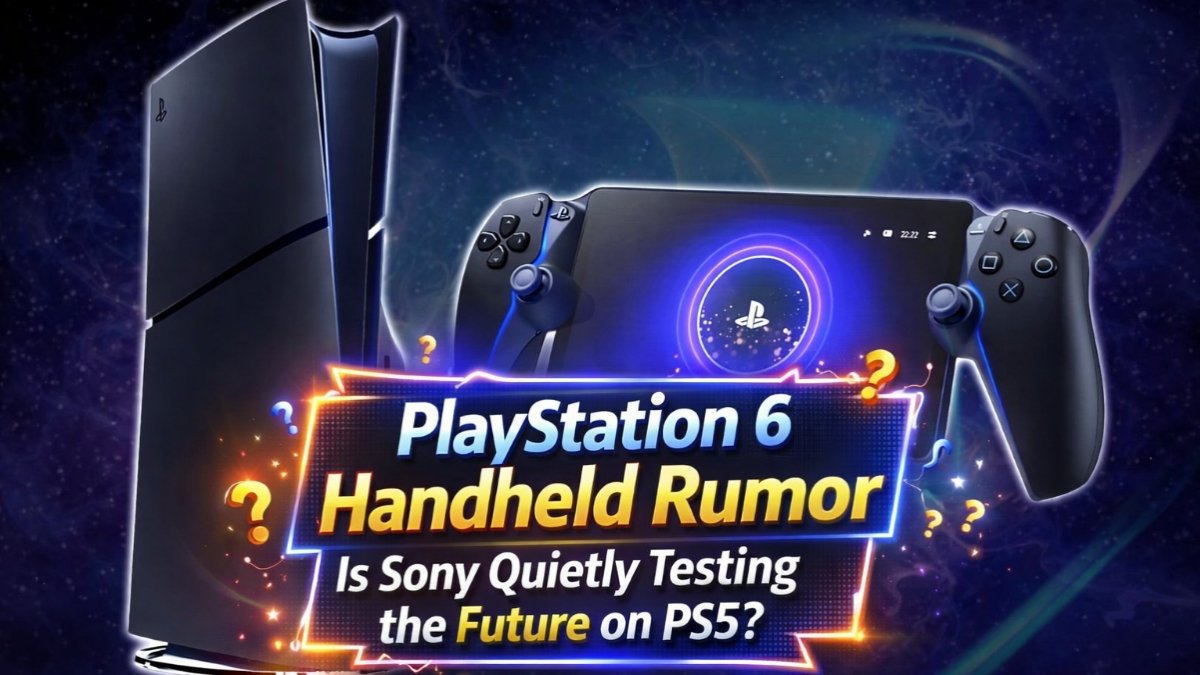
PlayStation 6 Handheld Leak: Why Sony’s New ‘Power Saver’ Mode Is Secretly a Portal to 2027
➞ When I first heard about Sony’s new Power Saver mode on PS5, I didn’t think much of it.
Honestly, it looked like just another feature tied to energy efficiency—something nice to have, but not exactly exciting. But the more I looked into it, the more I realized something didn’t add up.
The way this feature works… the timing… and the technical decisions behind it—it all points toward something much bigger.
In my view, this isn’t just a system update.
This is Sony quietly laying the groundwork for the PlayStation 6—and more importantly, a PS6 handheld.
Let me walk you through why I believe that.
PS5 Power Saver Mode Isn’t Just About Saving Energy
➞ At a surface level, Power Saver mode sounds simple. It reduces system performance to lower energy consumption. That’s standard.
But what caught my attention is how Sony implemented it.
Instead of just lowering clock speeds (which is the normal approach), the system restricts games to an 8-thread CPU profile.
That’s not typical.
From a technical standpoint, reducing threads doesn’t significantly improve power efficiency compared to voltage scaling. So naturally, I started asking:
Why would Sony design it this way?
The answer that makes the most sense to me is this:
Sony isn’t just saving power—they’re replicating a different hardware environment.
And that environment lines up almost perfectly with what we’re hearing about the PS6 handheld’s CPU configuration.
In simple terms, Power Saver mode feels like a simulation layer. It’s testing how games behave under handheld-level constraints—without actually having the handheld yet.
That’s not accidental.
PlayGo: The Feature That Quietly Changes Everything
➞ If Power Saver mode raised questions, PlayGo gave me answers.
This feature, discovered in PS5’s newer SDK updates, might not sound flashy—but it’s incredibly important.
Here’s the issue we’ve had for years:
When I download a PlayStation game, I’m downloading everything. High-resolution textures, multiple performance modes, assets I might never use—it’s all bundled together.
That works fine on a console. But for a handheld? Not so much.
What PlayGo Actually Does
➞ PlayGo allows developers to separate game assets into different packages.
That means:
- A PS5 Pro might download ultra-high-resolution textures.
- A base PS5 gets optimized assets.
- And a handheld system downloads only what it actually needs.
From my perspective, this is Sony solving one of the biggest challenges in portable gaming: storage and efficiency.
Instead of shrinking games artificially, they’re making them adaptive.
And that’s exactly what a PS6 handheld would need to function properly without compromises.
PS6 Handheld Specs: What the Leaks Suggest
➞ Now let’s talk about the part everyone is curious about—the hardware itself.
Based on multiple leaks and technical discussions, the rumored PS6 handheld (often referred to as “Canis”) looks far more powerful than I initially expected.
Expected Hardware Breakdown
- CPU: AMD Zen 6c architecture (8 threads)
- GPU: RDNA 5 with around 16 Compute Units
- Performance: Roughly 60–70% of PS5 in standard rendering
- Ray Tracing: Potentially 1.3x to 2.6x stronger than PS5
- Memory: 24GB LPDDR5X
My Real-World Perspective
➞ If I’m being honest, this doesn’t sound like a “lite” device at all.
It sounds like a proper next-generation handheld system.
Yes, it might not match PS5 in raw performance, but that’s not the point. What stands out to me is the efficiency and modern architecture.
That’s where handheld gaming is heading:
Smarter hardware, not just stronger hardware.
➣ What Every Gamer Is Reading Right Now
Warframe Weapon Tier List Guide – Top Meta Weapons Ranked
Best Pokemon Emerald Cheat Codes (Pro Guide)
How Sony Could Make PS5 Games Fully Playable on a Handheld
➞ One of the biggest questions I always see from gamers is:
“Will the PS6 handheld support PS5 games?”
From everything I’ve analyzed, Sony is clearly designing things so the answer is yes—and seamlessly.
The Likely Strategy
Here’s how I see it working:
1. Power Saver Mode
- Acts as a baseline performance profile
- Ensures games can run under reduced hardware conditions
2. PlayGo Asset System
- Adjusts downloads based on device capability
- Prevents unnecessary data usage
3. Unified Game Architecture
- One version of a game works across multiple devices.
Why This Matters
From a player’s perspective, this changes everything.
It means:
- No separate “handheld versions”
- No repurchasing games
- Instant access to your PS5 library
That kind of continuity is something Sony hasn’t fully achieved before—but now, it feels like they’re finally close.
Sony’s Shift Toward Affordable and Scalable Hardware
➞ Let’s talk about something that often gets overlooked—pricing strategy.
The reaction to the PS5 Pro made one thing clear: there’s a limit to how far gamers are willing to go on price.
And I think Sony is paying attention.
What Seems to Be Changing
Instead of focusing only on raw power, Sony appears to be prioritizing:
- Cost-efficient hardware design
- Scalable performance across devices
- Wider accessibility
My Take on This Strategy
From where I stand, this is a smart move.
A handheld device gives Sony the opportunity to:
- Reach more players globally
- Offer a lower entry point into the ecosystem
- Compete in markets where consoles struggle
If they balance price and performance correctly, the PS6 handheld could easily become a mainstream success, not just a niche product.
PS6 Release Timeline and the Growing Competition
➞ Looking at Sony’s history, the timeline makes sense.
- PS5 launched in 2020
- PS6 is expected around 2027
That’s consistent with their typical generation cycle.
The Competitive Landscape
By the time PS6 launches, Sony won’t just be competing with traditional consoles.
They’ll be up against:
- Next-generation Nintendo hardware
- Steam Deck and PC handhelds
- Cloud gaming ecosystems
My Perspective on This Battle
This is where things get really interesting.
Sony isn’t just entering the handheld space—they’re entering it with:
- A full game library
- Strong developer support
- Integrated ecosystem
That gives them an advantage they didn’t fully have during the PSP or PS Vita era.
The Bigger Vision: One Ecosystem, Multiple Devices
➞ When I connect all the dots—Power Saver mode, PlayGo, and hardware leaks—it becomes clear that Sony is aiming for something bigger than just another console launch.
They’re building a unified gaming ecosystem.
What That Looks Like
- One purchase
- Multiple ways to play
- Seamless performance scaling
Whether I’m on a console or a handheld, the experience stays consistent.
Why This Is Important for Gamers
From my perspective, this is exactly what modern gaming needs.
Less fragmentation. Less confusion. More flexibility.
And most importantly, more control for the player.
My Honest Opinion on the PS6 Handheld Leak
➞ After going through all the details, I genuinely don’t see this as just another rumor.
It feels like a deliberate transition that’s already happening behind the scenes.
Sony isn’t rushing to announce anything yet. Instead, they’re:
- Testing systems quietly
- Preparing developers early
- Building infrastructure step by step
If even a portion of these leaks turns out to be accurate, the PS6 handheld could be one of Sony’s most important hardware moves ever.
Not because it’s the most powerful device but because it could finally unify everything PlayStation has been trying to connect for years.

I’m Parth Patel, also known as iGPSYCHO, the founder of Immortal Gamers and a dedicated gaming content creator with a deep interest in gaming culture, strategy analysis, and eSports.