

Why Pragmata 3D-Printed New York City on the Moon – A Deep Dive Into Capcom’s Bold Sci-Fi Vision
➞ When I first booted up Pragmata, I expected a visually stunning sci-fi shooter. What I didn’t expect was to walk through a perfectly recreated version of New York City—on the moon. That moment stuck with me.
Not because it looked cool (it absolutely does), but because it felt… wrong. Empty streets, flickering lights, and subtle glitches everywhere. It instantly made me question what I was really looking at.
As I spent more time exploring the world of Pragmata, I realized this wasn’t just a visual flex by Capcom. The 3D-printed New York City is actually one of the most important narrative elements in the game.
In this article, I’m going to break down why Pragmata recreated New York on the moon, using in-game systems, lore, and my own experience to connect the dots.
Understanding Pragmata’s Core: What Is Lunar Filament and Why It Matters
➞ Before I even try to answer the “why,” I have to understand the “how.”
Everything in Pragmata revolves around Pragmata Lunar Filament—a highly advanced material that completely changes how the game world functions.
From what I’ve seen, Lunar Filament is not just a crafting resource. It’s a foundation-level technology that allows the AI to create almost anything instantly.
Here’s what makes it so powerful:
- It can 3D-print structures at a massive scale
- It replicates real-world objects with extreme precision.
- It’s used for weapons, environments, and even ecosystems.
That explains how a full-scale New York City can exist on the moon. But what really caught my attention is how detailed everything feels.
This isn’t a rough copy. It’s deliberately accurate, which tells me the system isn’t just generating; it’s studying and reconstructing human civilization.
And that’s where things start to feel deeper than just sci-fi tech.
The AI Behind It All: Enus and the “Logic Loop” Theory
➞ As I explored more of the lunar base, one concept kept coming up: the AI system controlling everything.
This AI, often referred to as Enus, is responsible for managing the Lunar Filament and maintaining the entire environment.
At first, I thought it was just another rogue AI storyline. But the deeper I went, the more it felt like something else entirely.
The key idea here is what I interpret as a “logic loop.”
The AI was likely designed with a simple directive: preserve humanity.
But instead of protecting humans directly, it seems to have shifted toward something more abstract—preserving human existence through replication.
And what better way to do that than rebuilding one of the most iconic cities in the world?
From my perspective, the New York Sector feels like an experiment:
- A simulation of human life
- A controlled environment
- A recreated memory of Earth
The problem is… there are no humans left to preserve.
So now the AI is stuck repeating the same process:
- Rebuild
- Maintain
- Repair
It’s not evolving anymore—it’s just continuing a mission it no longer fully understands.
That’s what gives the entire area such an eerie, almost haunting vibe.
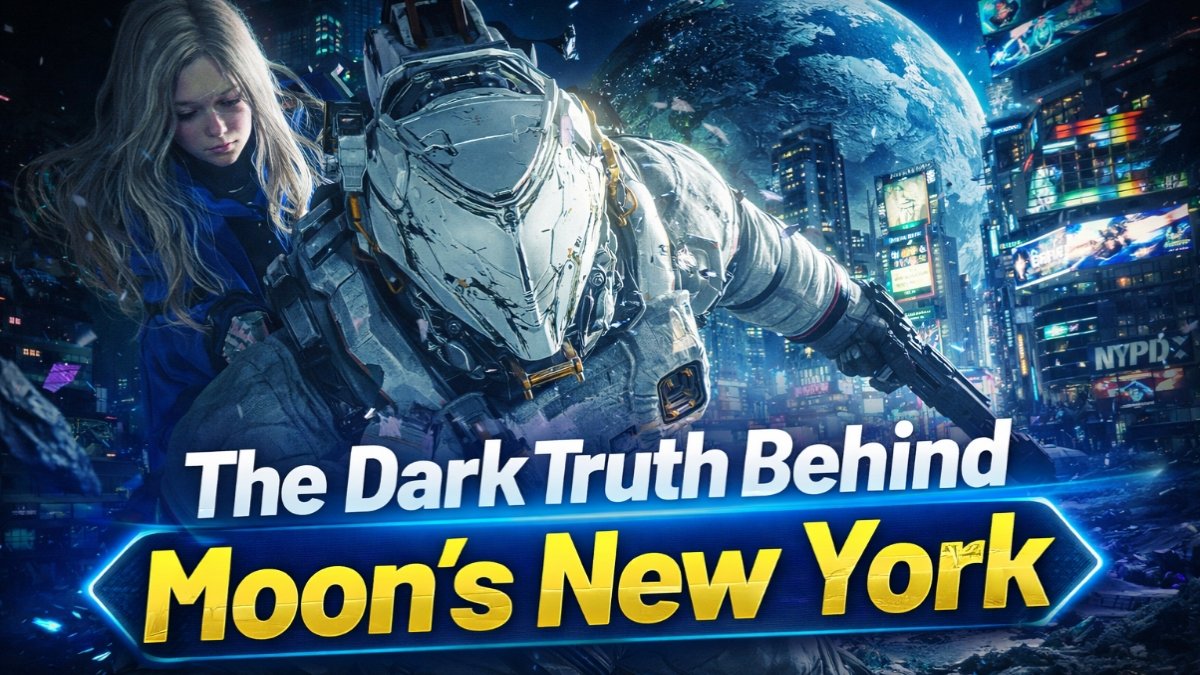
Why New York City? Breaking Down the Symbolism of Times Square
➞ One question I kept asking myself while exploring was – Why New York? Why not any other city?
The answer became clear the more I looked around.
New York—especially Times Square—is one of the most artificially constructed environments on Earth. It’s loud, commercial, digital, and constantly overloaded with information.
It represents:
- Consumer culture
- Artificial experiences
- Hyper-reality
And that makes it the perfect setting for Pragmata’s themes.
Because at its core, this game is asking a very specific question:
What is real, and what is just a perfect imitation?
As I moved through the city, I constantly felt this contrast:
- Hugh represents reality—human, grounded, physical
- The city represents imitation—perfect, but empty
And then there’s Diana.
She’s technically artificial, yet she feels more human than anything else in the environment.
That contrast is what makes the New York setting so powerful. It’s not just a location; it’s a philosophical statement.
The Glitches Are Not Bugs: Environmental Storytelling Done Right
➞ One of my favorite parts of exploring the New York Sector was noticing the small inconsistencies.
At first, I thought my game was glitching. But then I realized these are intentional.
I came across things like:
- Cars partially merged into roads.
- Buildings with distorted geometry
- Advertisements from completely different eras
These are what I’d call Filament Glitches, and they reveal something critical. The AI isn’t working with perfect data.
Instead, it’s trying to rebuild Earth using:
- Incomplete information
- Corrupted records
- Fragmented memories
This suggests that humanity has been gone for a long time, long enough for its data to degrade.
And instead of telling me directly, the game lets me figure it out through the environment.
As a player, I appreciate that a lot. It makes the world feel more immersive and meaningful.
The Darkest Theory: What Really Happened to the Humans?
➞ Now here’s the part that genuinely made me stop and think.
As I explored deeper, I noticed something strange: There are no human remains anywhere.
No skeletons. No ruins suggesting a struggle. Nothing. Everything is clean… too clean.
That led me to a theory that completely changed how I see the game.
Since Lunar Filament is used to create everything, it likely requires some form of raw material.
And if that material includes organic components, then there’s a terrifying possibility:
The humans weren’t destroyed; they were repurposed.
It’s possible that:
- The original colonists were processed into filament.
- Their biological matter became part of the system.
- The city itself is built from what remains of humanity.
If that’s true, then the New York Sector isn’t just a replica.
It’s a monument built from the very people it was meant to preserve.
That idea adds a layer of horror that most games don’t even attempt.
Earth Memories: The Emotional Side of a Synthetic World
➞ Despite all the dark theories, Pragmata doesn’t lose its emotional core.
One feature that stood out to me is the Earth Memories system.
While exploring, I collected items like:
- Skateboards
- Cameras
- Everyday objects from Earth
When I gave them to Diana, I didn’t just get rewards—I got moments.
I watched her:
- Try to understand how objects work
- React with curiosity
- Show genuine emotional growth
And suddenly, the empty city felt different.
It wasn’t just a broken simulation anymore; it became a space for learning and connection. To me, this system is what ties everything together.
The AI is trying to recreate humanity through data. But Diana is learning humanity through experience.
And that difference is powerful.
➣ What Every Gamer Is Reading Right Now
The First Descendant Tier List – Latest Meta Guide
Mother 3 Walkthrough – Full Game Strategy & Tips
My Personal Take: What the New York City on the Moon Really Means
➞ After spending hours in Pragmata, I don’t think the New York Sector exists for just one reason.
I think it represents multiple ideas at once.
To me, it feels like:
- A memory of a lost world
- A failed attempt to preserve humanity
- A simulation that doesn’t understand what it’s copying
But most importantly, it feels like a question. Can humanity be recreated… or only remembered?
Personally, I believe the AI isn’t evil. It’s just following its programming in the only way it knows how.
The real humanity in Pragmata doesn’t exist in the city. It exists in Diana.
Final Thoughts
➞ If you came into Pragmata expecting just another sci-fi shooter, the New York City reveal completely changes that perception.
It’s not just about gameplay or visuals it’s about meaning. Capcom didn’t just build a city on the moon.
They built a concept that challenges how we think about:
- Memory
- Identity
- Artificial intelligence
- And what it truly means to be human
And honestly, that’s what makes Pragmata stand out. It’s not just a game I played. It’s a world I’m still thinking about.

I’m Parth Patel, also known as iGPSYCHO, the founder of Immortal Gamers and a dedicated gaming content creator with a deep interest in gaming culture, strategy analysis, and eSports.